

Queer Mexico
Queer liberation requires solidarity globally, we want to better understand the experiences of our queer families across the world as well as close to home.
Mexico is a country with a rich and vibrant LGBTQ+ heritage and faces its own challenges when it comes to queer equality and safety.
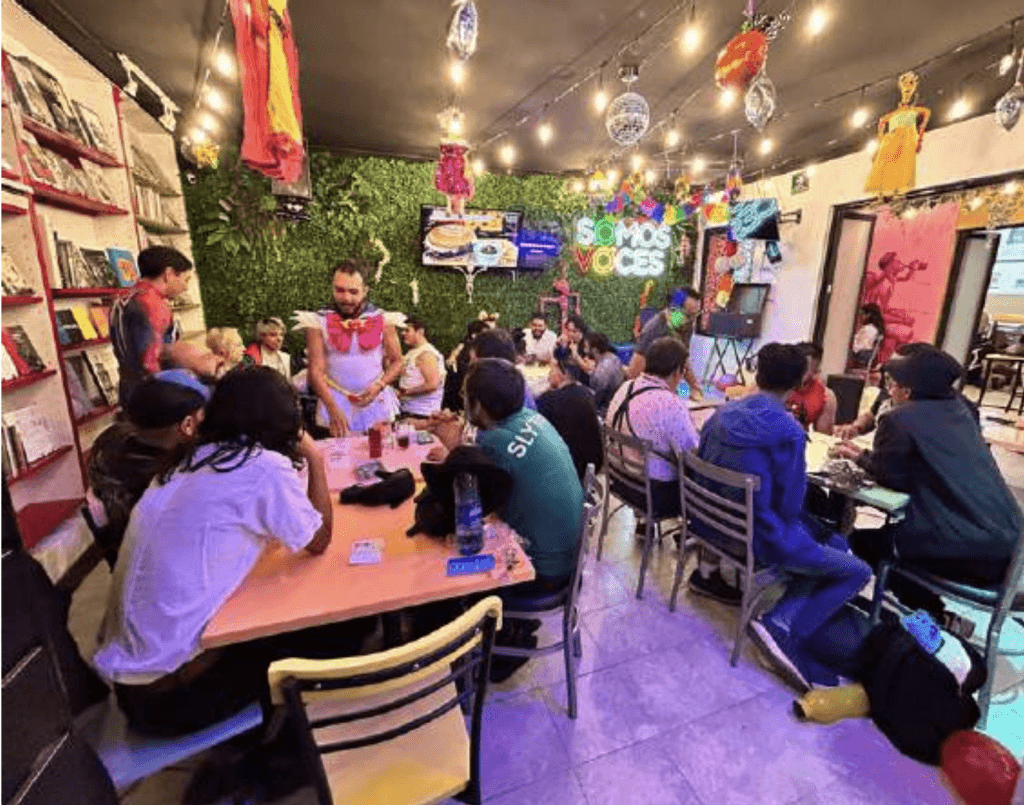
Thankfully the country is home to safe spaces such as Mexico City’s queer event space and bookshop cafe, Somos Voces.
We spoke to them to find out more about their project…
Can you tell us about the aims of your project please? How was it started and what activities do you provide?
Since 2009 Somos Voces has aimed to provide safe spaces for the growth, learning and engagement for socially sidelined populations due to sex, gender, gender identity or sexual orientation.
We pursue to create and enhance proposals for the development of LGBT community through art, culture and education in order to raise awareness among the general population to dignify our lives.
How accepting is Mexico City and Mexico in general for queer people?
In general terms, about the situation of the country, Mexico City has been a benchmark for inclusion and promotion of LGBT rights, however there is a lot of work to be done with general populations, where there is still strong resistance towards sexual diversity and it is visibility in everyday life.
In the UK we are currently fighting a backlash against trans people, is it the same in Mexico?
Unfortunately, due to the bias and misinformation, the violence and discrimination to trans people stands strong in our country, particularly towards trans woman and trans-feminine persons.
How is the community responding to transphobia in Mexico?
In some way, the relationship between the trans community and the rest of the population produces some familiar dynamics; on the one hand the exhibition and exoticisation of trans people in the media for entertainment is applauded and on the other hand, people ignore the situations of direct violence and marginalisation of trans people.
Queer Cumbria works a lot with queer artists, we find queer people use art a lot to fight inequality, is it the same in Mexico City?
The sexual diversity movement in Mexico began to gain greater visibility in 1978.
In its beginning, a significant proportion of the activism belonged to the cultural and artistic field.
Nancy Cárdenas and Juan Jacobo Hernández, to mention two iconic characters who came from the theatre.
Several people who participated in this liberation movement of that decade were part of the artistic movement and around 1987 the Gay Cultural Week emerged, coordinated by José María Covarrubias
(La Pepa) who would strongly promote the cultural and artistic theme, promoting a wide cultural offering in different places, mainly in Chopo University Museum.
This event continues to be held under the name of the International Festival of Sexual Diversity (FIDS) an event of which we are the venue, and with which we collaborate closely to strengthen the presence, visibility and discussions that we consider fundamental for our sexually diverse communities.
This issue of our magazine is working in collaboration with Woman Up, do queer and feminist groups work a lot together at Somos Voces?
Definitely in Somos Voces there is a great receptiveness for collaboration between different communities, different perspectives and positionings.
For Somos Voces it is very important to take care of alliances, based on productive relationships of solidarity, empathy and sensitivity to the particular situations that frame the development of every collectivity or community.
What would you say is the main priority when It comes to cultural events this year at Somos Voces?
This year we are celebrating Somos Voces XV years.
The priority in addition to our anniversary celebration has been the same for some years, addressing the issues that concern sexual diversity from a complex and contextual approach.
Every year we try to place topics that we consider important.
The sexually dissenting population is present everywhere, which is why we consider that we need to build an offer that is updated month after month from an intersectional approach, in order to be aware of everything that happens in our context, both Mexican and Latin American, and even international.
Would you say there’s an underrcurent of feminism in your cultural events?
Totally, for us the content and objective of the speeches that are created here in our space are very
important.
We ensure that, regardless of the topic we work on, it is done with a gender perspective and with respect for the various communities that trust Somos Voces as their safe place.
Can you talk a little about how inclusive feminism is important to you?
For Somos Voces, the productions from feminism with an inclusive perspective allow us to analyse and
understand the phenomena that come along with our community from a perspective open to the subjectivities and intersectionality that frame sexual and gender diversity as well as the dissidence of patriarchy.
What can queer people in the UK learn from community activism in Mexico?
We consider it extremely important to understand that each struggle is contextual, and that there are very particular factors in our countries, but perhaps some contributions that the Mexican case could
make is the need to make a turn to the dissident communities that are mostly exposed, such as the trans, non-binary people, etc.
This implies thinking about the ethnic, migratory, and class situation, among other factors that make the living conditions for certain groups much more complex (intersectionality).
Another aspect that we have learned is not to speak for others, nor to usurp spaces of enunciation that do not belong to us, as well as to respect the autonomy of each struggle.
In many cases it has only been necessary to remain silent and simply support.
Definitely, one aspect that we practice at Somos Voces is to renounce tutelage and paternalism.
In Mexico there are historical experiences that have been repeated in our populations, such as considering certain groups as minorities, as has happened with indigenous communities, which has prevented them from achieving their autonomy.
Or also that someone, an external agent, usurps the voice, so we consider that each community has to organise, defend its needs and expose its problems freely.
Solidarity, respect and support is essential in these fights.
Interview by Stevie Westgarth
Photography by Somos Voces
www.somosvoces.com.mx
LATEST POSTS

Thrim’s Journey: The Origin of the Midges
A folk tale interpretation about the origin of the midges, written by Samantha De La Parra. After Ragnarok, a long […] Read More