

Vibes and Stuff

Piercer Dr Beet has modified much of the queers in North Cumbria, and it’s all down to vibes alone.
But it’s not by intention, the business owner is simply able to cultivate reliable trade, through the queer grapevine it’s his name that has become synonymous with safe and queer friendly.
“It’s so much calmer here.
“You walk in, there’s a little oasis of plants and crystals, and it’s just really calm space versus the very clinical feeling, which I understand it has to be clinical because you want it to be clean, but it doesn’t need to feel like you’re walking into a butcher’s shop,” said Zed, who was getting his conch – the inner convex surface of the ear – lanced, while describing why he keeps coming back to see the doctor.
“Some of the places you walk in and the first thing you notice is the smell of disinfectant and everything is white and empty and it feels like a hospital room.
“You walk in here and it actually feels like somebody wants to be here.
“It feels like a little home, and then he was just super friendly.”
He said they and Dr Beet spent about an hour and half just chatting the first time they met, sharing a conversation during which he asked for his preferred name and pronouns, which he does indiscriminately for every client.
There aren’t many piercers, and none other that I know of, that proactively ask for someone’s preferred name and their pronouns before being pierced for the first time.
You’ll be handed an iPad with a form asking you the basics – are you drunk, are you of age, are you being coerced etc. – and to put your legal name, for insurance purposes only, and what you like to be called.
He assures everyone that he doesn’t see the legal name and can only see it if it’s absolutely necessary for some reason, and only sees that one name.

“I’ve actually been getting piercings since I was 21, so over a decade.”
He said when he got a job that didn’t allow piercings they closed up, then he found a new one which did so was looking for a new place.
He said he didn’t want to go back there as the person he was used to left, and didn’t know the new one – familiarity is something important with a procedure so intimate.
“One of my friends actually suggested Dr Beet because they come here and they said that it was a very friendly, safe, queer friendly, not particularly judgemental, place.”
He said his friend recommended this place due to past experiences with bigotry.
“I think there’s just a lot of very casual transphobia and bigotry and stuff.
“I think what they were thinking for me personally is that they knew I’d started to transition a bit more socially and dress a little bit more appropriate to how I felt, and I think they knew at the time that I felt quite self-conscious in some places because, yes, I got misgendered all the time, and I don’t always feel comfortable speaking up.
“They just thought they clearly could come here and had a good experience and felt safe.
“I think they knew that I was looking to get my piercings redone and just thought it would be somewhere where I wouldn’t feel immediately targeted and singled out and already coming in knowing that you’re going to get stabbed in the face.”
Everyone gets pierced for different reasons, for some it’s purely aesthetic, and for others it’s more meaningful.
For Zed, it’s a way to communicates inner self to the world.
“A lot of the time I find that it does weirdly help to affirm my presentation.
“I try to avoid piercings that are seen as very traditionally feminine, and I do feel like my eyebrow one, especially when I got that, I was like, oh, yeah, that makes my face look really masculine.

“It just helps me to feel more in line with how I feel, even with just a piercing.
“It’s not just about your clothing and your hair and stuff like that.
“The way you present everything about you helps to fit the puzzle pieces together to make a idea of who you are on the inside, on the outside., and also I’m a sucker for pretty jewellery.
Familiarity is also important for neurodivergent people, which Zed is, as is Dr Beet himself.
In fact everyone who came through the door while I was sitting in was queer and on the autistic spectrum.
Research from the University of Cambridge, published in the journal Autism Research, suggested autistic people are more likely to identify as some kind of LGBT identity/sexuality than non-autistic people.
In the largest study yet on this topic, the Autism Research Centre surveyed autistic people on their sexual activity, orientation, and health.
Out of 1,183 and 1,203 autistic and non-autistic people respectively aged 16-90 provided information.
The results showed that autistic people are around eight times more likely to identify as asexual or an ‘other’ sexuality than non-autistic people.
Autistic males are 3.5 times more likely to identify as bisexual, and autistic females are three times more likely to identify as homosexual.
There’s no consensus on why this is, but one explanation is that autistic people may be less reliant on social norms, and therefore more open about their orientation or gender identity.
Dr Beet has ADHD and considers himself to be queer as well, so this scenario could also be a classic case of finding one’s tribe – neurodivergent and queer.
The doctor said he does make mistakes sometimes, as everyone does, with pronouns and names, it’s a human thing, but he’s making a difference by going out of his way to ask those questions on the form which should be commonplace.
On why he does it, he explained more about his identity and path: “There is a woman inside me somewhere, but in very much a drag queen sense.
“There’s something in there, but I would always say I’m cis male.
“I live in a very straight world, but I’m the black sheep of all my circles.
“I’m the queer, I’m the other, that’s fine, because I’m loved in circles.”
He said a member of a queer charity in Carlisle came for a piercing and told him he can get certified as a safe space from them.
“If there’s anything I can do to help people feel more comfortable, I will, because I was always raised with a whole ‘treat of people how you want to be treated’ thing, and that sticks with me because I know what the fuck it means to be mistreated.
“I’ve been mistreated for my queerness, and I’ve been mistreated for my brain, and I think if you’re not constantly making yourself grow and evolve, what’s the fucking point?
“I am forever on a healing journey and a growing journey.
“If I ever stop that, then something’s wrong, it’s a pathological obsession at this point.
“But then I just did realise I am still very much a queer safe space, and I have very much accidentally become a neurodivergent safe space.”
Tara came all the way from Penrith to get her nose pierced.
“There’s no judgment and there’s no weird, creepy vibes.
“It’s just good vibes, all around good vibes.”
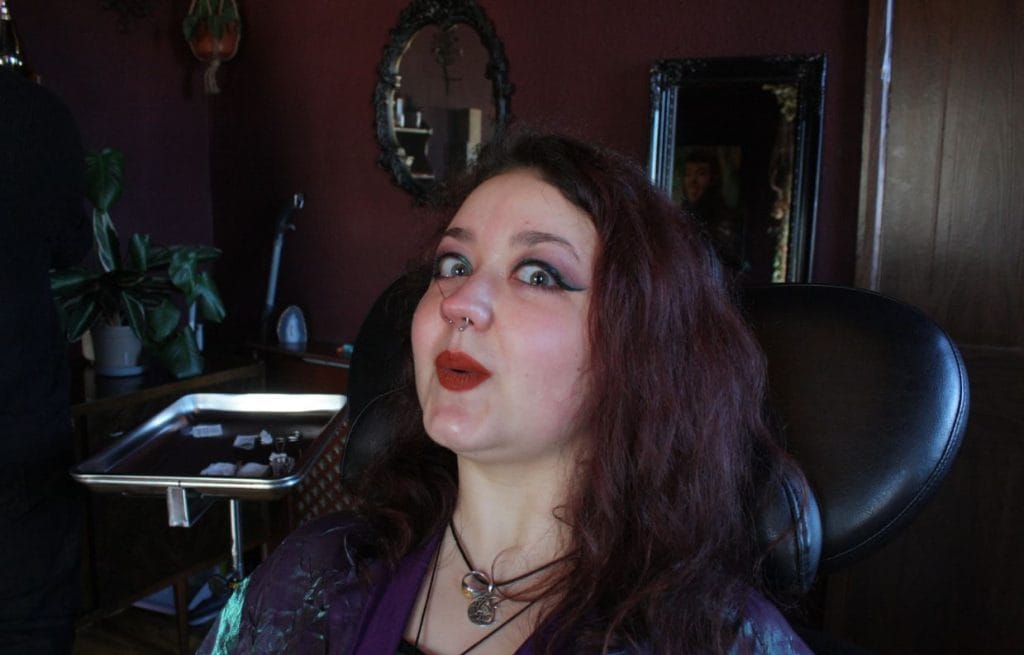
She suggested the reason why there seems to be a link between queerness and being pierced is that it’s a statement, and also a way to feel comfortable – perhaps mirroring your feelings visually.
Dr Beet said there are a few things that come to play.
“There’s a cross-off between the queer and neurodivergent as well, for sure.
“I can’t explain why or what, but I think when you are something other. self-expression comes into it.
“I also think as queer/neurodivergent people, we are probably more sensitive, and with that comes pain.
“With that comes a search for other types of pain.
“Personally, I don’t actually like that explanation.
That maybe explains why you see people saying they’re getting their nose pierced after a breakup with their partner, maybe, or less gruesomely, why they dye their hair – much in the same way the Hindu goddess Shiva is representative of destruction, destruction is simply change, making space for healing.
“It’s an alternative to something that’s unhealthy, a permanent reminder of a milestone that you’re able to go through.
“It’s something to go, ‘I made it through that, and I’ve got a little lovely piece of jewellery to show for it,” Tara said.
Piercings also plainly have a queer history, at least in the western world.
The doctor said
“In San Francisco in the 80s it was part of the queer BDSM kink scene, the right halo was a signifier that you are with your people,” the doctor said.
“And then it evolved from there into that ’90s heavy BCR ring piercing. Since then, it’s just become fashion.”
Tara also said as an autistic person, piercings communicate that and make it less painful to unmask; the doctor concurred.
“Like I said, it’s still fashion, but I remember I would always, when I was a teenager, have black hair and piercings.
“My mum would be like, ‘Can we put some of those piercings away and maybe dress a little bit smarter around grandad.
“The only way I can describe it is a pain.
“If you can’t be yourself, it’s like being squished into a box that you don’t want to be in.
“You feel closed in and weird and over stimulated and uncomfortable, and you just don’t feel right.
“Doing anything to avoid that and feel the opposite of that is good.
“I wondered years ago, why is it certain people look a certain way and do certain things?
“Why do goths wear black?
“It’s got to be a reflection on the inside, it’s got to be.
“It’s just vibes.”
Words and photos by Seph Santiago
LATEST POSTS

Thrim’s Journey: The Origin of the Midges
A folk tale interpretation about the origin of the midges, written by Samantha De La Parra. After Ragnarok, a long […] Read More