

From Saturday Girl to Saturday Town
One of our fellow Queer Cumbrians has a fantastic exhibition running, detailing the faces and experiences of our LGBT youth.
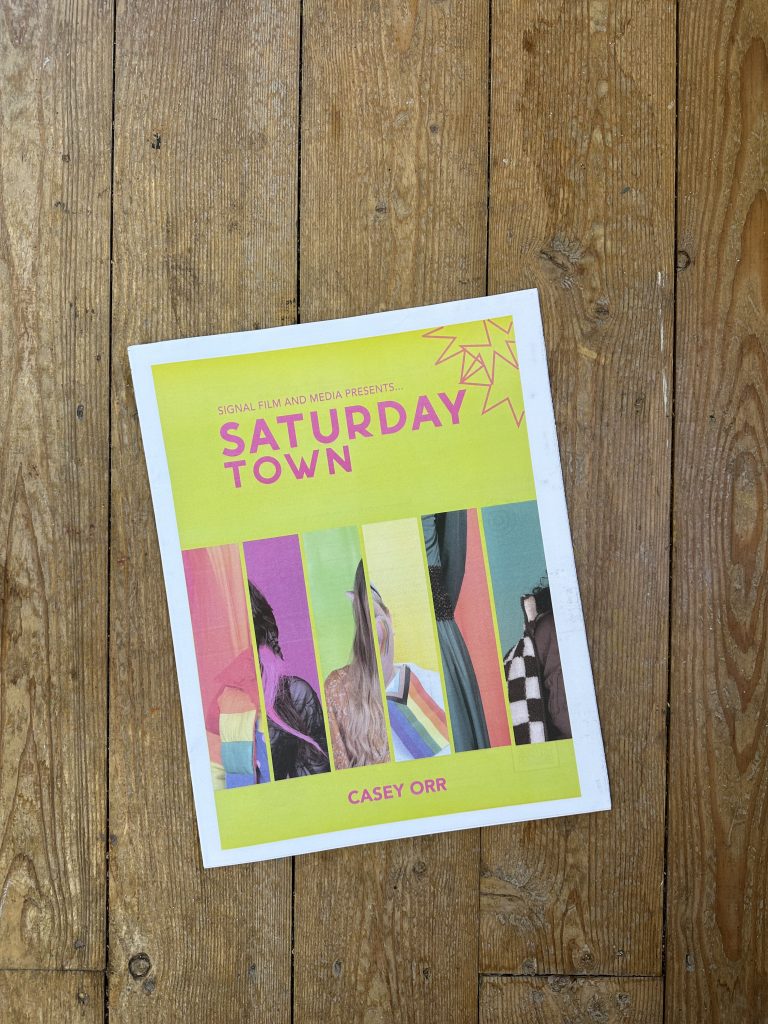
Curated by Barrow-based Signal Film and Media, the award-winning photographic project titled Saturday Town, by Casey Orr, will launch at Barrow railway station on September 19.
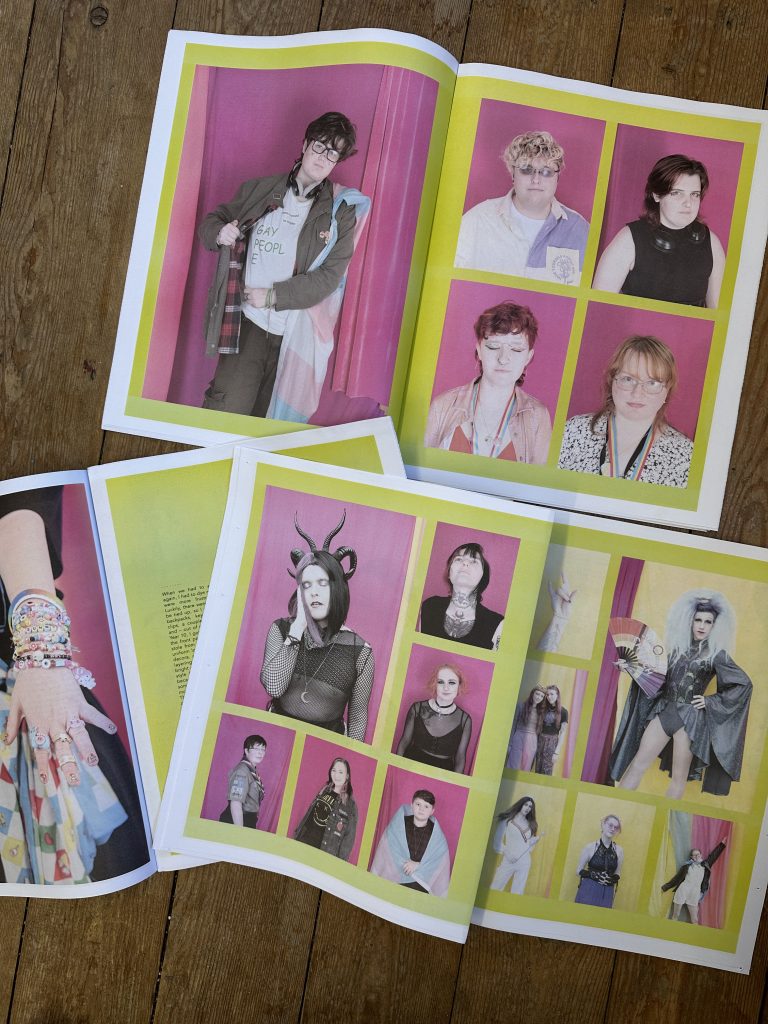
Saturday Town is about the powerful, playful language of fashion and how our changing culture can be read through the ways young folks communicate visually.
It celebrates youth culture, fashion and self-expression.
Photographer Casey Orr travelled the UK with a pop-up portrait studio, photographing in towns and cities on Saturday afternoons since 2013.
Since then she has photographed hundreds of young people, documenting over a decade of major changes in culture, identities and the ways we use our public spaces.
Casey has been in Cumbria with her pop-up portrait studio throughout 2023-24 meeting and photographing young people throughout the region.
A full-colour, large-format newspaper will be launched alongside the instalment of images at the station.
This full-colour publication captures Casey Orr’s huge selection of new and unseen portraits of young people in Cumbria.
The photographs and full-colour newspaper are a celebration of the region through this playful, colourful and also nationally significant photographic project.


To learn more about the artist, here’s an interview between herself and Phillip Northcott, co-curator of Signal Film and Media, that took place last month:
What brought you to being a photographer based in the North of England?
I came to England from the United States in the 1990’s and I’ve lived in Yorkshire since then. My husband is English, which is why I ended up in the UK. I’ve been a photographer ever since I arrived. Straight away I was totally fascinated by the history and culture of the north of England – I especially loved the towns and cities and how people would get dressed up to go out!
People treat their time away from work and school as a sort of celebration, really thinking about how they present themselves. I’ve always loved this, the way that people spend time on the weekend, Saturdays offering a freedom, from work, family, school. Promenading has always been a part of the weekend rituals and a place to speak the language of fashion, of the self. Now, as I’ve worked on my project over the years, I can see that this really comes from a working class culture of celebrating the time together, celebrating the time when you’re not at work.
Could you tell me a little bit about the origins of Saturday Town?
I started thinking about Saturdays, and what Saturdays mean to people, like how important that day is when you have that freedom from work. I kind of see it as before and after what happened during Covid. I started Saturday Town as Saturday Girl in Leeds in 2013. Before I began the project I started to see young women in the city centre with big hair and hairpieces and wigs and I wondered what it all meant – I wanted to find out, to ask them! The fashion looked like they were very much connected to previous generations, they had a look that appeared kind of handed-down from their grandparents, grandmothers and further back in history. And these young women would come out on Saturday afternoons, so that’s where I came up with the idea of setting up a portrait studio in the city with bright colours – because as we know in this country it’s often grey and raining! – and I thought, I need to do this under wraps and I need it to be a space where there’s continuity with the lighting, and I set it up so that I could always, no matter what the weather, go out and ask people to be photographed.
What genre of photography do you feel it relates to the most?
Really, I see it as documentary photography, as street photography that has a look of fashion – that’s how it started. I did that for a year in Leeds. That first collection was exhibited in 2014 and I thought the project was finished. But then I was invited to the LOOK Photo Biennale in Liverpool in 2015 to continue the project. When I photographed in Liverpool, I realised they were doing something very different than the young women in Leeds. The young women and people in Liverpool were presenting themselves and their sense of fashion and identity with a very different flavour. It seemed to me that the way we present ourselves is a language and if fashion is a language, it has a dialect – and of course there’s a very different dialect in Liverpool. When I realised that, I started to wonder what young women were looking like in Brighton? What about Glasgow? Belfast? I decided I would travel across the UK, photograph and find out – is there a dialect to the language of fashion and the self?
I travelled to 17 cities and towns throughout the UK and I worked on this project until 2019. Boys now started to come into the studio. The idea of the word ‘girl’ in 2012/ 2013 was very straightforward – there was a simple binary meaning. But of course the world has totally changed since then. I began to see that people were starting to identify in different ways, the binaries of gender started to fall away. I started to feel like I was reading changes in culture through who was coming into the studio and how people were identifying. I felt like I was able to distinguish what’s happening in society through this really sophisticated and playful language of photography and fashion and of the self.
But again, once I had finished that long tour of the country with Saturday Girl, and I published a book with Bluecoat Press, I thought, “OK, I’m done.”
Then the Covid Pandemic changed everything…
Absolutely. Everything that we had known, all the spaces that I had photographed, the people, it was all gone – shut, locked down. What young people lost during that formative period amongst many other things was that ability to promenade and help define themselves. All dressed up and nowhere to go!
Before Covid, being in town on a Saturday meant trying out your visibility and your physical connection with other people, you’d go out onto your high street and you’d be trying out a look. How does this feel to be this person in the world? And you might think, “Oh, this is me. I’m goth” or whatever. Or you might go out, and you would try something and if it wasn’t right – you’d know it wasn’t right because it didn’t feel right when you were out on the street.
It felt very shocking to me that this project I’ve been working on, this experience for young people and also the spaces themselves, it was all disappearing – and I thought, there’s something really important, something seismic going on right now… and when we’re allowed back out, I need to be on the street to document it.
So when we came out of lockdown I started the project Saturday Girl about Town, which was less about the big cities and more about northern towns and northern places. I love that there are young people everywhere doing sophisticated, playful, creative things and it doesn’t have to be a ‘big city’ experience. The young people here in Barrow are doing incredibly playful, complicated things with identity and that’s very much across the board, across northern towns.
I wonder what particularly struck you about the young people and their vibe in Barrow?
I think that the physical spaces of towns mostly aren’t the places where everybody’s finding their vibe, their identity, right now – because their starting point often begins before they venture out, it’s online.
During the pandemic, young people were connecting everywhere through their screens. It was more democratic and they were able to find their subcultures and discover really sophisticated groups of people who they could identify with, from all over the world.
But the Saturday promenading is still incredibly important – this sense of being out to see and be seen on the high street, it’s been going on since Victorian times. Promenading moved into retail spaces for a lot of the 20th century in the form of large shopping centres. Then the shift onto online shopping changed things again, a change accelerated by Covid. And now we’re in this “what will happen next?” situation. With the way our town centres are changing, where will we go to meet? The typical high street was always more than just a place to go shopping.
Definitely. This leads into this question about what is the American equivalent of Saturday Town, if you know of one? Is there still such a thing as ‘Mall culture’?
Well, the malls are dying. Which is interesting, because the mall was my town centre, my high street – it’s where I did my hanging out!
Well, that’s my next question, what was Casey Orr’s version of Saturday Town?
My version, growing up in the small state of Delaware, was just that – The Mall. But for me, the big kind of explosion in my life was MTV and seeing all those cool bands in the eighties when I grew up, especially a lot of the British music. It felt like I could somehow find my place in it. But it’s interesting that you ask what the Saturday Town is in Delaware because I’m doing a Saturday Town project there right now in Wilmington, where I’m from. I’m working with a photographer called Julia Gorton, who is one of the original New York punk photographers from the 70s. Julia does a pop-up portrait studio, photographing counterculture, cool kids all over the States. So we have connected. We’ve realised that we both have the same hometown and so we are doing a project there. And even though it’s thousands of miles away, I’m asking the same questions about identity and self – I want to know where the LGBTQ communities are and how that is playing out for young people. And of course, there’s all the falling away of binaries there just as there is here, and it’s happening within the schools and everywhere. I’m really interested in working there, to meet young people there and introduce them to young people in Barrow! That would be fascinating. What I want to do is to connect them all so that they can start to form their own relationships and their own collaborations.
Let’s finish with your experiences of working in the West Coast of Cumbria?
I didn’t really know the towns and landscape of the West Coast. It’s so removed from the kind of places I’d previously photographed. It’s not really on the way to anywhere. But I’ve spent time there now and I love it, it’s just so inspiring to see there are queer identities, so many other identities, and I just think that people in smaller places who are being themselves are so inspiring and brave. Being around people who are being themselves enhances my life because it makes me realise that I need to be myself completely.
I just think that they’re making it clear that there is a wider abundance of identities. It gives me hope that there’s a more expansive world to come. It just blows me away. They’re just pushing the boundaries in a way that allows for more freedom for more people. They’re doing this work and they don’t even realise it! It’s like service to their community. It’s so important to see somebody who you think, oh, so I can be who I want to be.
LATEST POSTS

Thrim’s Journey: The Origin of the Midges
A folk tale interpretation about the origin of the midges, written by Samantha De La Parra. After Ragnarok, a long […] Read More